This lesson's interactive features are locked, please to keep using them
You're on assignment part 2/2 for this lesson.
Linked List vs. List
A linked list is a collection of ordered items, so it's similar to a "normal" list (also called an "array" or "slice" in other languages).
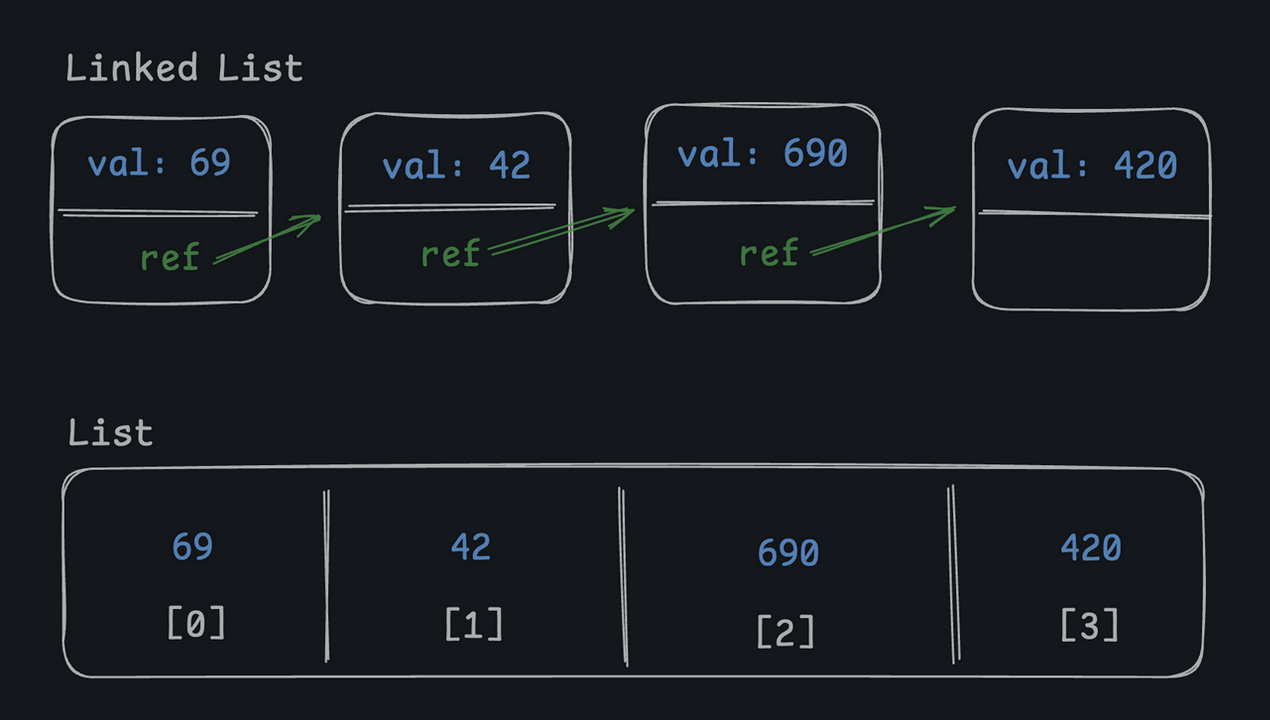
Items in a "normal" list are stored next to each other in memory, and to get an item from a normal List we have to use a numbered index:
car = cars[3]
You can think of the "index" as simply an offset from the start. The cars list in this example refers to the start of the list, and 3 is just the 4th item in that section of memory. With a normal list, all the data is stored in the same place in memory and the index is just a way to find the right spot.
In a linked list, there are no indexes! Each node contains two things: the data itself, and a reference to the next node in the list. Iterating over a linked list requires starting at the head node and following the next references until you reach the end.
current_car_node = head_car_node
while current_car_node is not None:
    print(current_car_node.val)
    current_car_node = current_car_node.next
Frankly, linked lists can be annoying to use and incur more overhead, so why use a linked list at all? It's because sometimes linked lists are much faster to make updates to, particularly when inserting or deleting items from the middle.
In a normal list, if you insert an item in the middle, you have to shift all the items after it down one spot, which takes O(n) time:

In a linked list, once you've traversed to a given node, insertion is (O(1)) because you can simply update two references:
