You're on assignment part 3/3 for this lesson.
Queue Speed
So how fast are queue operations? Well, in an optimized queue, they'd be:
| Operation | Big O | Description |
|---|---|---|
| push | O(1) |
Add an item to the back of the queue |
| pop | O(1) |
Remove and return the front item from the queue |
| peek | O(1) |
Return the front item from the queue without modifying the queue |
| size | O(1) |
Return the number of items in the queue |
Just like a stack, all operations are O(1)! No matter how many items are in the queue, these operations will always take the same amount of time. The reason to choose a queue over a stack is all about ordering. Queues should be used when you need to process items in the order they were added.
LIFO (stack) vs FIFO (queue).
A Problem
Our current Queue class has a problem... take a look at the push method:
def push(self, item):
    self.items.insert(0, item)
It's not O(1)! The List's insert method has to shift all the other items in the list down to make room for the new item.
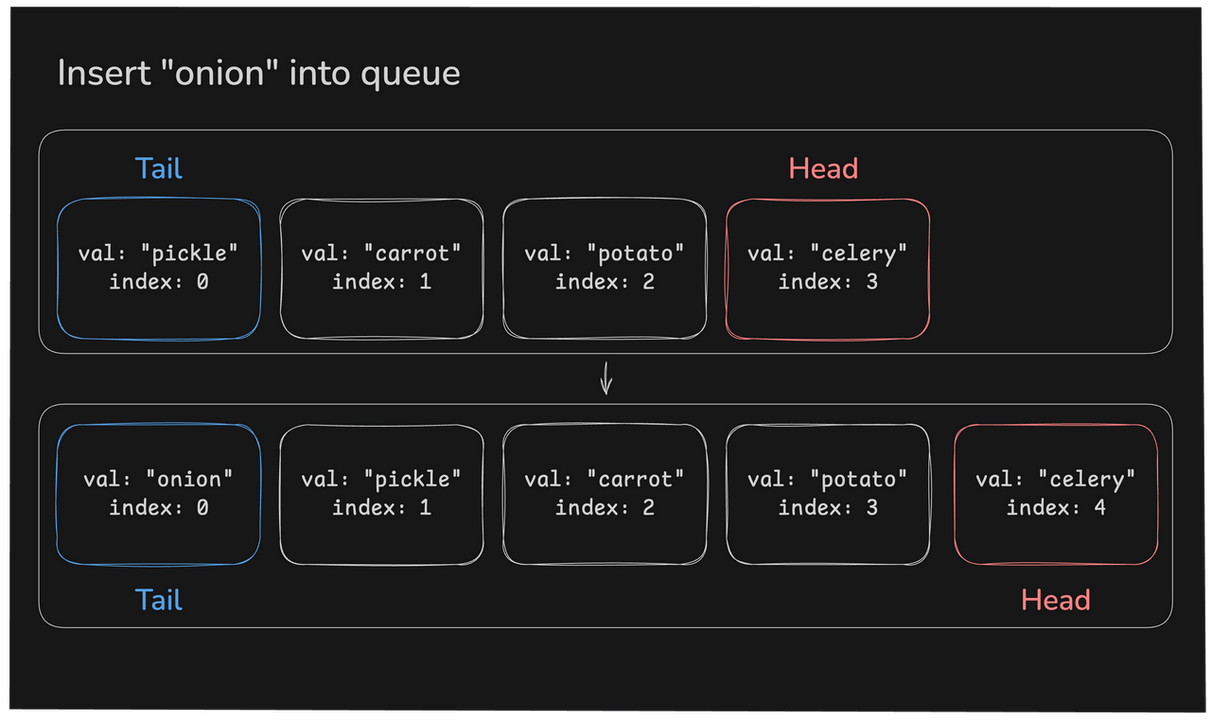
We'll solve this very solvable problem soon...