You're on assignment part 2/2 for this lesson.
Hash Map Review
Hashmaps are awesome. They are simple to use and have an average computational cost of O(1) for lookup, insertion, and deletion operations.
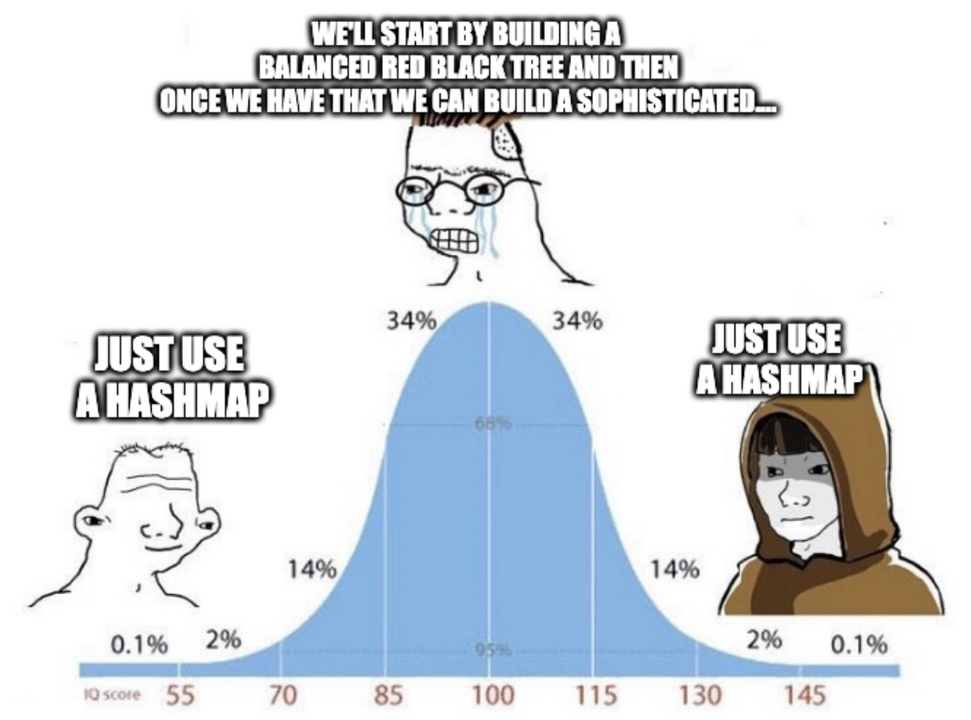
In Python, that means dictionaries. In Go, it means maps. In JavaScript, it means object literals. The point is, if you need an in-memory key-value store, hashmaps are awesome, and every language tends to have a built-in implementation.
Properties of a Good Hash Map
- Fast Lookups: Hashmaps have an average time complexity of
O(1)for lookups, insertions, and deletions. - Unordered: Hashmaps (typically) do not guarantee any particular order of keys.
- No Ranging: While hashmaps are great for lookups, they don't provide the ability to look into a range of keys (e.g. the largest ten keys). That's one reason production databases like Postgres use binary trees for indexing.
- Collision Resistant: Hashmaps are built on top of arrays and use a hash function to convert a key into an index. Production-ready implementations (like Python dictionaries) handle hash collisions and make them a non-issue in practice.
- Hashable Keys: Keys must be hashable. This means they must be immutable and have a consistent hash value. For example, in Python, a tuple can be a key, but a list cannot.
- Efficient Resizing: When a hashmap's capacity is exceeded, it dynamically resizes (usually by doubling in size) and rehashes the elements. A good hashmap manages this resizing efficiently, minimizing performance hits.
- Uniform Distribution: A good hash function ensures keys are distributed evenly across the hashmap's underlying array, minimizing the number of collisions and optimizing lookup speed.
Our Toy Hashmap
Our toy hashmap:
def key_to_index(self, key):
    sum = 0
    for c in key:
        sum += ord(c)
    return sum % len(self.hashmap)
Has a few big problems, but at least it's valuable for understanding the concepts. Some of its big problems are:
- It doesn't resize when it gets too full, and doesn't handle collisions
- Its hash function is simplistic and doesn't distribute keys evenly